
What can sculpture tell us about the world we are becoming? For Aotearoa New Zealand artist Gill Gatfield, the answer lies where ancient stone encounters artificial intelligence and histories embedded in objects open onto uncertain futures. Working across sculpture, installation, public art and computational practice, Gatfield was a barrister and solicitor in the areas of human rights and law reform before completing a MFA at Te Waka Tūhura Elam School of Fine Arts and Design in Auckland in 2004.
Her work explores questions of gender, justice, memory and power through forms that are at once materially grounded and conceptually expansive. Her recent residency in Montegiovi brought her into closer dialogue with Italy’s marble traditions, a history she approaches as a material and cultural language to reconsider.
Gatfield’s sculptures have been shown internationally, including in New York and Tuscany, and currently at Futura Art Gallery in Pietrasanta, an exhibition curated by Claudio Francesconi. She has also been selected for the biennial Sculpture on the Gulf on Waiheke Island which opens in February 2027, curated by Heather Galbraith and Benjamin Work.
VITRINE: Your practice has always seemed to sit between things that endure and things that disappear: stone and code, monument and apparition, deep time and emerging technology. What is it about that tension that keeps bringing you back to sculpture?
Gill Gatfield: Sculpture is a love affair. It’s heady and sensual, especially when matter, code and encounter operate at different speeds. That friction is generative, not a contradiction to resolve. A work may have a fixed material origin yet an unstable spatial presence. It might be monumental yet fleeting, or present through absence. It can be textual and totemic. Or all of this, at once, yet minimal. These transformations change how we measure ourselves in space and time, and how we exercise agency. An early project, In-Out (2003), used mirrors without centers that reflected viewers at the margins, creating a staccato rhythm as people moved. That work put binaries under pressure, drawing me towards liminal territory, where rules loosen and both the artwork and its viewers find room to stretch.
VITRINE: You recently spent time at La Baldi in Montegiovi, Italy, working through the landscape and its ecologies, and extending the research to Carrara and the traditions of Italian stone carving. What did being physically inside that landscape teach you?
GG: In Tuscany, stone refuses to stay in the past. From my studio at the top of Montegiovi, the ancient mass of Monte Amiata rose beyond the olive groves. Working inside the walls of the medieval village, among the remains of a fortified castle, I could see one century built into another. Hewn from volcanic ground, these stones have seven lives: endlessly reused, reordered and returned. Carrara was another world. The white capped peaks evidence fresh cuts into rock. Inside the cathedral-scale chambers carved into the mountain, I tasted marble dust in the air. This immersion in stone and landscape informed my site-responsive activations of ‘In Absentia’ in Montegiovi, Pietrasanta and Rome. The virtual arch, formed by two crystal-glass I-figures, rises from a codified Athenian column. In Montegiovi, under the fierce summer sun, the translucent forms almost dissolved into the ancient stone walls. As people moved around and through the sculpture, they co-created its presence. In the responses, something uncanny emerged: a monument that occupied no ground, yet felt as though it had always belonged to the square.


VITRINE: You’ve said that the residency also brought you into questions of extraction, labour, landscape and the gendered mythologies embedded in Mediterranean stone traditions. Did anything you encounter in Italy unsettle or change the assumptions you had brought with you?
GG: At Carrara’s quarries, the global appetite for new stone became palpable. Stone is held close and reused in the villages. Here, marble is excised in mammoth blocks for distant destinations. These mountains store the memories of centuries of extraction, from Roman antiquity to industrial production. Running my fingers into wire cuts on the quarry faces was like touching wounds. The anonymity of where this stone lands is a far cry from where it began. Across Etruria and Latium, myth inhabits stone. At Monte Circeo, I stood among limestone cliffs and caves entwined with the legend of Circe, the enchantress who transformed Odysseus’s men into swine. At Etruscan archaeological sites and archives, I studied carved stones I had previously only known through photographs, bringing their first-person inscriptions startlingly close. Dating from the Archaic period onward, these inscriptions preserve names, lineages and declarations, including matronyms. Alongside the visibility of Etruscan women in ceremonial and social life, these discoveries complicate the male-centred histories of classical antiquity. Tracing these voices through stone brought my sculptural I-form into dialogue with an ancient lineage, sharpening questions for my work of whose presence and authority survive through time.


VITRINE: Carrara marble comes with an almost overwhelming history: Michelangelo, the Renaissance, the monument, the idea of the sculptor imposing form on matter. Did experiencing Carrara at source make you feel part of that lineage, or did it make you want to disrupt it?
GG: Yes, both. Working with marmo means entering its histories and present conditions. Carrara carries these in spades. The myth of the solitary master-carver is potent but unravels against the mountain. Rock splits and falls, storms undo roads, and workers risk their lives. Michelangelo worked for two years with teams of roadbuilders and stonecutters in the Medici quarries above Pietrasanta, sourcing marble for the façade of San Lorenzo. Renaissance masters relied on workshops of carvers. Five centuries later, the tools and pace have changed, but the work still demands technical agility, collaboration and steel nerves. I negotiate form with each stone as carved and coded matter, informed by its origins and resistance. Drawing, computation, robotics, extended reality and many hands enter that process. The solitary hero is an increasingly narrow model for sculpture.
VITRINE: You have described your Italian project as an act of ‘re-inscription’, in which inherited forms encounter future protocols. What does it mean to re-inscribe a tradition rather than simply inherit it?
GG: For me, re-inscription means changing the terms of an inherited idea or form – not simply its appearance, but what it carries, includes or excludes, and how it can operate anew. With In Absentia, the classical arch becomes a virtual threshold, the Etruscan I-form an avatar, and an Ionic column derived from the Athenian Acropolis a coded foundation. Athena’s shifting identities across Mediterranean cultures – from Greek Athena to Etruscan Menrva and Roman Minerva – are themselves acts of re-inscription. Goddess of wisdom and war, she was also patron of technē – craft, skill and technological invention. Beneath a village memorial to the fallen, ‘In Absentia’ cast a circle of digital I-shadows across the square. As arch, text and column refuse closure, forms bound to authority can be portals into other ways of being.
VITRINE: You explain AI²AR as a matrix of exchange: Artificial Intelligence Ancient Intelligence Augmented Reality. It’s intriguing because it refuses the usual opposition between ancient knowledge and technological futures. What do you mean by ‘ancient intelligence’, and what can it offer that artificial intelligence cannot?
GG: AI²AR is a matrix of exchange: Artificial Intelligence ↔ Ancient Intelligence ↔ Augmented Reality. I place ancient intelligence at its centre, drawing on geological, material, biological, ancestral and inherited forms of knowledge. It carries worlds before and beyond human dominion, through rock, root and living bodies. Within this wider field, ancestral intelligence moves across generations, through instinct and memory, soma and senses, myth and symbol. These intelligences remain situated and active, not a universal resource for technology to mine.
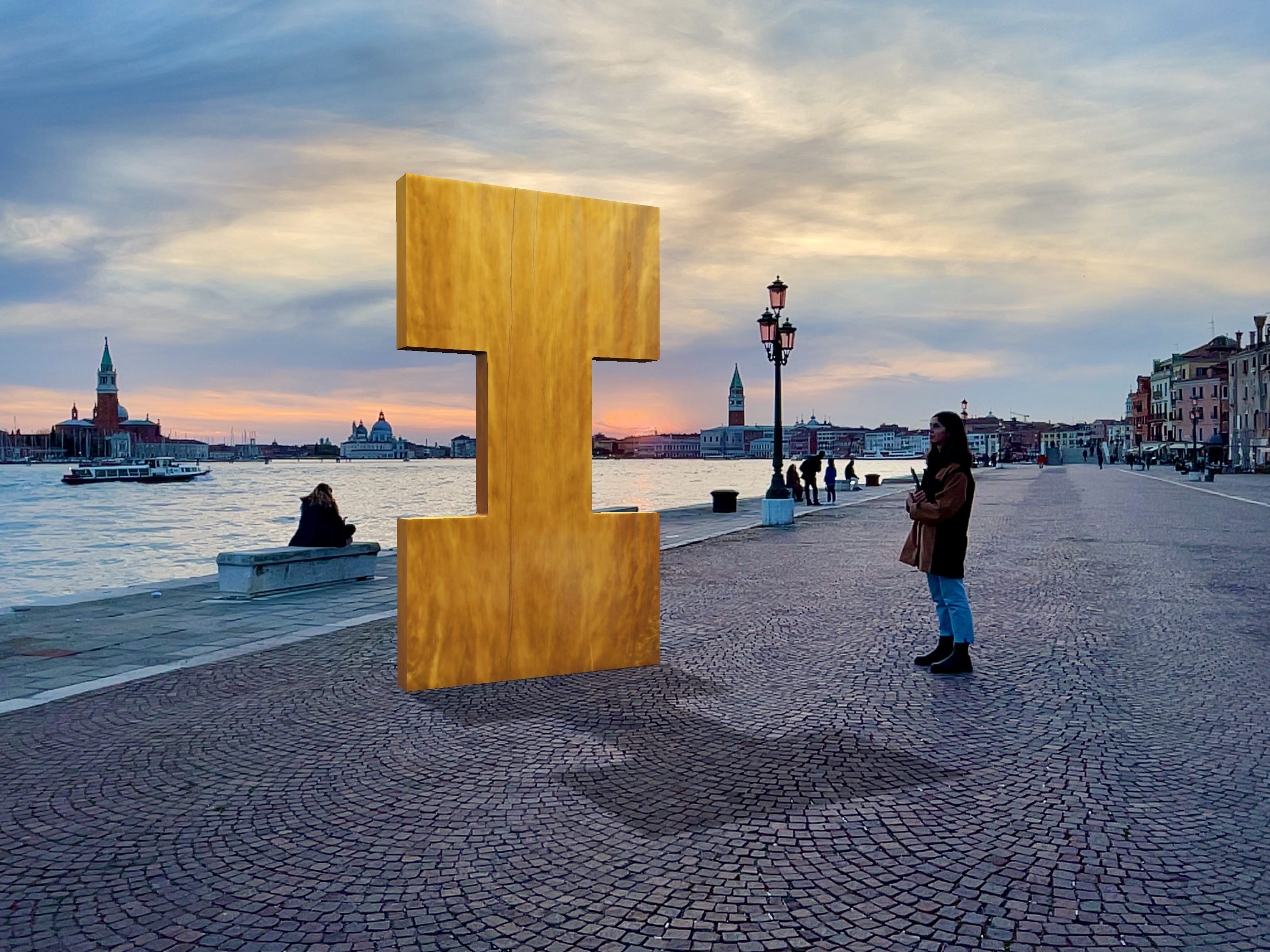
An ongoing project, ‘Native Tongue XR (2018–)’ explores ancient matter in digital space. Carved from the heartwood of ancient kauri over 45,000 years old, the three-metre I-form enters augmented reality at full scale. Its codified grain carries deep time. At once the first-person pronoun and the number One, the sculpture invokes an Other I. Its abstract tongue suggests a passage between the physical world, the subconscious and mystical realms.
The sculptural “I” gives form to non-human presence. An AI agent speaking in the first person is another proposition. I have coded my AI agents not to use “I”. That voice carries a sovereignty I choose not to cede to a machine.
VITRINE: Your earlier work often engaged directly with the human body. Its proportions, its representation, its political and social meanings. Increasingly, your work seems to ask what happens to embodiment when our experiences are mediated by screens, algorithms and extended reality? Has technology changed how you think about the body?
GG: Technology has been part of my work from the outset, with early experiments exploring the body through absence and action. In the early 2000s, I co-authored paintings with a robot I named Flo, testing authorship and authenticity beyond the artist’s touch. ‘Please Touch (2010)’ signalled the arrival of the iPad, placing works from my grass roots series behind the tablet’s glass screen. Invoking VALIE EXPORT’s screen provocation and Marcel Duchamp’s tactile breast forms, the grass tablet subverted the conventions of touch, while the device itself became the greater object of desire. Extended reality, robotics and AI open new territories where embodiment becomes a question of presence, access and control. ‘CHIP (2025)’ invites viewers to release its virtual kauri I-form from a Carrara column, while its corporeal twin ‘Avatar (2025)’ reclaims material presence from the datasphere. The body migrates across object, avatar, machine and viewer, testing where embodiment begins and ends.
VITRINE: Your background in law and public policy is unusually present in the conceptual architecture of your work. In pieces such as ‘Habeas Corpus (2025)’ legal language becomes almost sculptural. Do you still think like a lawyer when you make art? Or has art changed the way you think about law?
GG: As a lawyer, I thought like an artist, using different tools. Law reform and systems design were creative work asking, “What if?” Public policy taught me how to work for and with people. Not an abstract public, but individuals and communities with diverse experiences and agency. Writing Without Prejudice: Women in the Law (1996) took that thinking across centuries of legal history, moving from critique to imagining and developing alternative institutional systems. That understanding continues to shape how my work engages its audiences. In ‘Habeas Corpus’ the writ “you have the body” becomes spatial: who possesses, protects, releases or speaks for a body? Padded and woven walls form anechoic membranes around a white space that is both sanctuary and cell. Storied stones invest columns with civic legacies, while real and virtual bodies negotiate confinement and liberty. The invisible workings of law, structures and code can be felt when your own body enters the room.


VITRINE: There is an extraordinary physical seduction to your work: marble, gold, copper, ancient wood, glass. Yet beneath that beauty are questions about power, gender, justice, sovereignty and the systems that shape how we live. Is beauty, for you, a way of drawing us towards difficult ideas?
GG: In my practice, beauty is not a disguise for critique. It can move us sensually and emotionally, beyond the grasp of thought. We can find it within materials, ideas and forms, without more. What sets synapses firing is subjective, shaped by cultural codes of taste, desire and power. Yet this private play of perception aspires to shared validity. ‘Harmony (2022)’ condenses these tensions into miniature I-figures of pounamu, alluvial gold and Tākaka marble that gleam against black velvet in a gilded frame. The work’s allure is entangled with complex legacies of representation, colonial trade and sovereignty. Beauty doesn’t erase those histories or resolve their contradictions. It allows them to be felt. Beauty can be unruly: it surfaces, recedes and persists, sometimes resisting the very systems that shape it. It can inhabit critical enquiry, offering nurture, replenishment and reprieve. Finding something beautiful can feel like being free.


VITRINE: ‘Tablet (2026)’ brings together Carrara marble, copper, gold inscription and an AI-AR extension. It recently won Aotearoa’s Small Sculpture Prize. You describe it as a ‘future archive in a deep-time register’. What, ultimately, is being archived in Tablet? Is it information, memory, power, or something more elusive?
GG: ‘Tablet (2026)’ holds potential. Its compact geometry brings the ancient stone tablet into contact with the digital device. Its Fibonacci-derived gold barcode operates as inscription and interface, signalling an AI-AR extension that only its future owner can unlock. The sculpture is materially complete, yet part of its presence remains latent. Ancient tablets preserved law, lore and records across generations. ‘Tablet’ re-inscribes that inheritance, archiving not simply information but the conditions of its transmission. Its deep-time register spans geological time in marble, gold and copper, and millennia of knowledge inscribed in stone. As Sara Buoso observes in Segno, legibility does not confer permission. Where ‘CHIP’ releases, ‘Tablet’ withholds. Unlike my public XR sculptures, ‘Tablet’ makes access exclusive and privacy a sculptural condition, disrupting expectations of digital immediacy. Ownership becomes a question of guardianship and care. This enquiry began with my ‘Grass Paintings (2006-2013)’. They flourished when tended and became dormant when neglected, without dying. With Tablet, the decision to activate passes into other hands. The time it is held, the care it receives and the possibility of release shape what the sculpture may become.


VITRINE: You have worked with materials that carry long histories, including ancient kauri, while also working with technologies that can become obsolete almost overnight. What happens to the idea of permanence when the physical and the digital are placed inside the same artwork?
GG: Permanence is something of an obsession. My studio is littered with test pieces exposed to light, weathering and technological failure. One irony is that the disposable nappies in my ‘Nappy Fields (2002–25)’ would endure for centuries in landfill. By contrast, a digital body can struggle just to appear. Days before my New York exhibition opened, after repeated failures, CHIP’s virtual I-head suddenly emerged from my screen – a difficult birth.
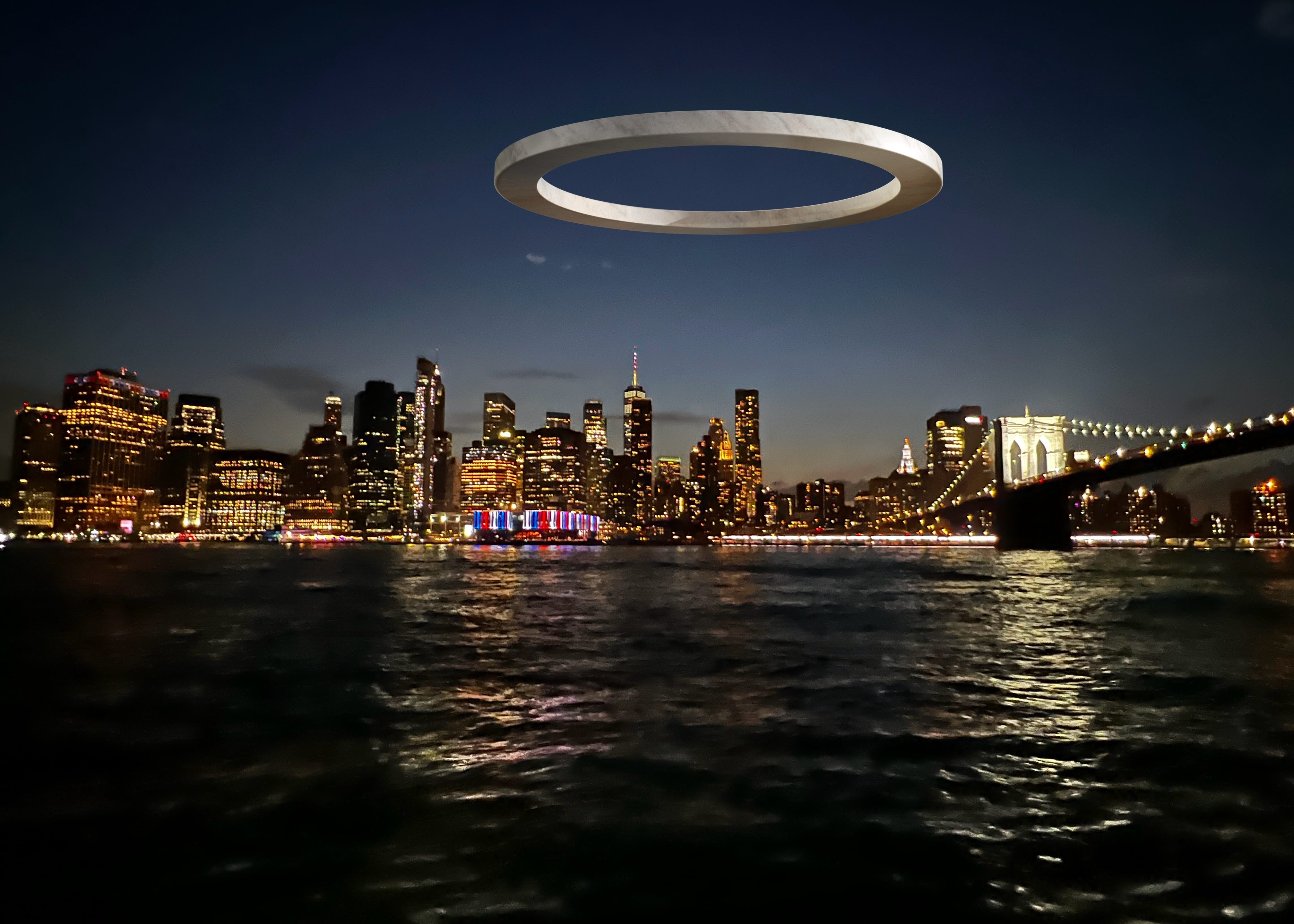
For ‘HALO (2023–)’, time spent researching marble in the mountains of Tākaka informed a 21-metre virtual stone circle, translating geological matter into code and Earth into atmosphere. Stone erodes; hardware and software become obsolete. Neither physical nor digital form promises permanence. What intrigues me is how a work might endure through transformation: a fleeting virtual encounter can leave a lasting memory, outliving the apparatus that made it visible.
VITRINE: Yet, at a moment when contemporary life is increasingly virtual, networked and ephemeral, you remain deeply drawn to things that endure, like stone, inscription, landscape, monument. What new possibilities and responsibilities does this open for sculpture?
GG: I find this technological turn both exhilarating and disturbing. Projects I could once only imagine are becoming possible, but possibility is not the same as progress. I’m developing a new body of work, Computational Sculpture, where digital systems and robotic carving meet ancient matter, material resistance and cultural codes. My ongoing Ephemeral Monuments enquiry shifts monumentality beyond scale and permanence towards presence that emerges through activation. From intimate physical sculptures to gallery and public installations, these enquiries test how place and participation shape what a work becomes. What connects these strands for me is ancient intelligence and beauty. Both can do more than survive technological upheaval. They can shape what comes next. Perhaps the monument of the future will learn to listen as well as speak.
Learn more about Gill Gatfield at https://www.gillgatfield.com and follow Gill on Instagram
An interesting and deep interview, leaving a desire to follow more of her work.